
The short version is that japanese tea garden design begins with a journey, not a shopping list of ornaments. A tea garden, or roji, traditionally provides a setting for approaching a tea gathering. For a home garden, start with a comfortable path, a sense of transition from the street or house, and a quiet place to pause. You can borrow those ideas without building a teahouse or pretending to reproduce a formal garden.
What makes a tea garden different?
Roji is often translated as “dewy ground,” and the word refers to the garden associated with a Japanese tea space. In tea practice, the passage through the garden can help mark a shift away from everyday concerns before guests enter the tea room. The garden is part of hospitality, not simply a view to be admired from a window.
Tea gardens developed alongside Japanese tea practices, particularly from the late sixteenth century onward. They vary by school, site, and historical period; there is no single template that accounts for every roji. Some have an outer garden and an inner garden separated by a gate, with places for guests to wait or prepare before entering the tea room.
The spare, weathered look often associated with these spaces is connected with tea's appreciation of restraint and ordinary materials. It is worth resisting the idea that every mossy stone carries one fixed symbolic meaning. A path also has a straightforward job: it gets guests where they need to go.
Planning a path for japanese tea garden design
Begin at the point where someone actually enters your yard or patio. Where would you like them to slow down, and where will they sit or drink tea? Sketch a route between those points before choosing stones. A modest change in direction can create a sense of arrival without making a small space feel like a maze.
Stepping stones, known as tobi-ishi, are a familiar feature in many tea gardens. Choose stones with reasonably flat, stable tops and set them securely so they do not rock. Arrange them for a natural stride rather than copying a photograph: people of different heights and mobility levels need different clearances.
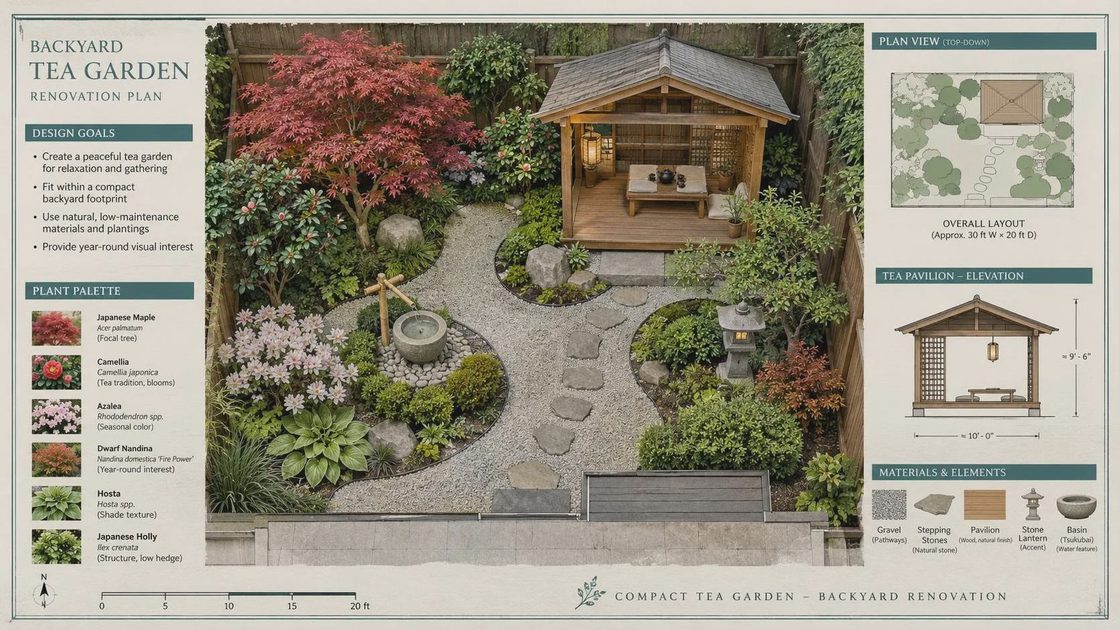
Traditional-looking stones are not worth a fall. If you or your guests use a cane, walker, or wheelchair, a firm, level, continuous path may be the better choice. You can still suggest a slower transition with a bend, a change in paving texture, or planting along the edge. Keep the route wide enough for its intended users and avoid surfaces that become slick when wet.
A simple gate or screen can distinguish the garden from the rest of the yard. It need not be elaborate: a wooden fence panel or a planted boundary can frame the entrance. Leave enough room to open the gate and move through comfortably, especially if the path turns immediately afterward.
Water, waiting, and the tea gathering
A stone water basin is one of the most recognizable tea-garden features. In a traditional setting, guests may use a basin to rinse their hands and mouth before entering the tea room. A low arrangement commonly associated with this practice is called a tsukubai. Its placement and use belong to a wider sequence of hospitality, rather than to a universal garden formula.
At home, a basin can be a visual reference rather than a ritual station. If you intend guests to wash, provide clean, usable water and a sanitary way to access it; a decorative basin with stagnant water is not a substitute for a sink. Position any vessel where splashes will drain away from the path, and empty standing water regularly to discourage mosquitoes. If children visit, consider the safety of any water container.
A waiting place is just as useful and usually easier to install. A plain bench under partial shelter gives a guest somewhere to settle while water heats. Place it where a person can see a patch of planting or the approach to the tea space, rather than facing a storage area. In a tiny garden, a movable chair can do the same work.
Choosing plants for japanese tea garden design
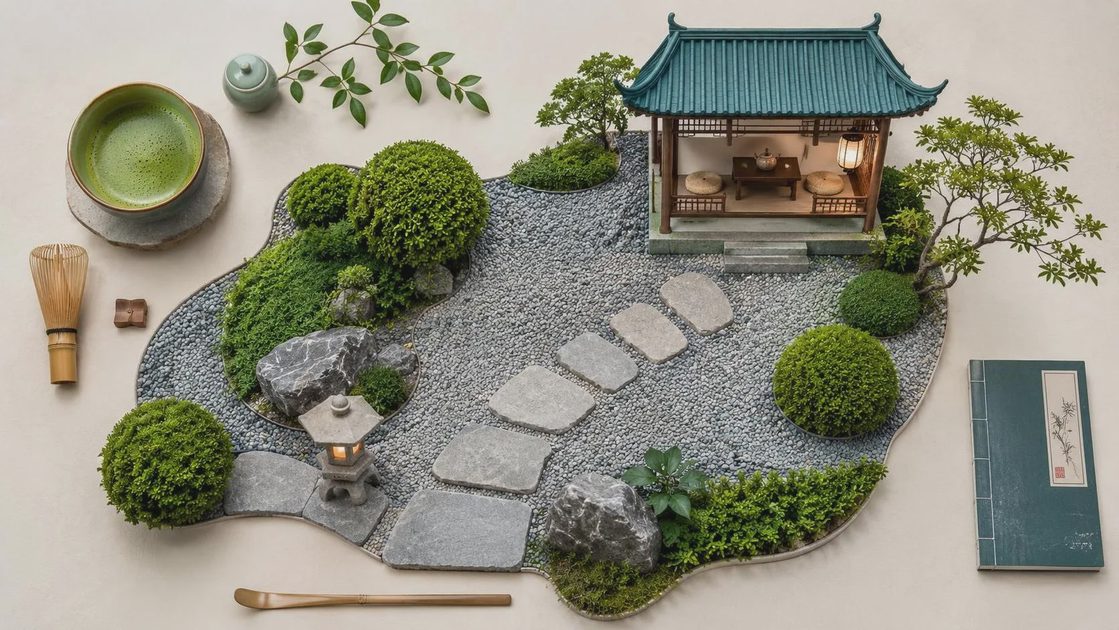
Think in layers rather than assembling a collection of plants marketed as Japanese. An evergreen shrub can provide structure, a small tree can offer shade, and low groundcover can soften the edges of a path. Choose species suited to your local climate, soil, light, and water supply; regional native plants may work beautifully in a tea-garden-inspired space.
Moss is appealing, but it is not a magic carpet for every yard. Many mosses prefer moisture and shade, and a hot, dry patio may not provide either. Where conditions are unsuitable, consider leaf litter beneath shrubs, gravel, or a low-growing plant appropriate to your area. Keep groundcover away from walking surfaces if it makes them slippery or hides the edges of stones.
Pruning deserves a gentle hand. The goal is to preserve clear passage and reveal the structure of a plant, not to force every shrub into a perfect ball. Leave enough room for plants at their mature size, and keep branches away from faces and shoulders along the route. Ask a local nursery about invasive plants before bringing in an unfamiliar groundcover.
A small-space plan you can use
For a narrow side yard, try a stable path leading to a single chair or bench, with a screen at the entrance and shade-tolerant planting where conditions allow. A small basin can sit beside the destination if it has a practical purpose and does not narrow the route. One well-placed object often does more for the feeling of the space than several lanterns competing for attention.
On an apartment balcony, the “path” might be no more than the few steps from the door to a chair. A planter can partly screen the view of a utility area, while a small outdoor table holds a cup. Check building rules and weight limits before adding stone or large containers, and never obstruct an exit or drainage.
Finally, plan for upkeep. Sweep leaves from the walking surface, reset any loose stones, and check drainage after heavy rain. A garden that welcomes a guest on an ordinary afternoon is a more useful starting point than a scene assembled for a photograph. You can appreciate the ideas behind the tradition while being honest that your own space is an adaptation.



No comments yet — be the first to share a thought.