The short version is that tea history begins in China, where people developed ways to prepare leaves from the tea plant, Camellia sinensis, before the drink spread through trade, migration, religion, and empire. Along the way, communities made tea their own: whisking powdered leaves, steeping loose leaves in pots, adding milk and spices, or serving it over ice. There is no single original ritual that explains every cup today.
Early tea in China: What do we know?
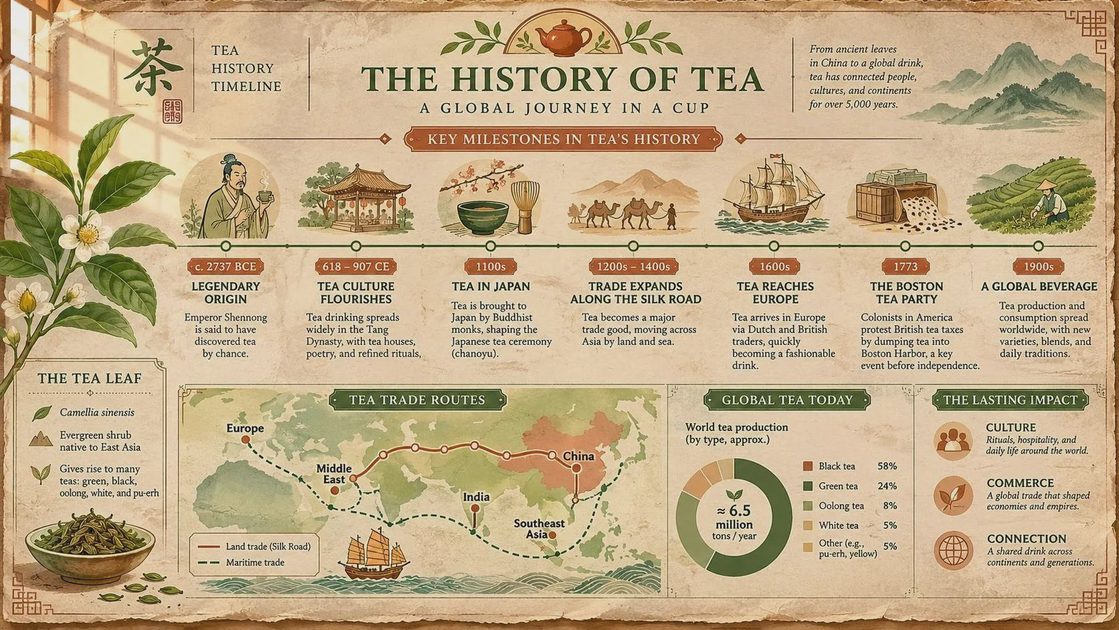
The tea plant is native to a broad region of East and Southeast Asia, and people have used its leaves in more than one way. The story often told about its discovery features the legendary ruler Shennong and a leaf falling into hot water. It is a memorable origin story, not an event historians can verify.
The written record gives us firmer ground. By the Tang dynasty, which lasted from 618 to 907, tea drinking had become well established in China. The writer Lu Yu compiled the Classic of Tea in the eighth century, describing tea production, utensils, and preparation. His book is an important source, though it tells us about the practices and ideals he recorded, not how every person drank tea.
Tea history also includes forms that look unfamiliar beside a modern tea bag. Leaves were processed into compressed cakes; pieces could then be broken off and prepared for drinking. During the Song dynasty, from 960 to 1279, powdered tea whisked with hot water became especially associated with elite tea culture. Methods changed over centuries, and loose-leaf steeping eventually became widespread.
A useful distinction for beginners: green, black, white, oolong, and dark teas all come from Camellia sinensis. Their differences come from plant varieties, growing conditions, and processing. Herbal infusions such as peppermint are enjoyable drinks, but they are not made from the tea plant.
Tea travels to Japan
Tea reached Japan from China, with Buddhist monks among the people who helped carry knowledge of it. Its history there stretches back more than a thousand years, though the customs familiar today developed gradually rather than arriving as a finished package.
Powdered tea became especially significant in the practice now often called chanoyu, or the Japanese way of tea. In a tea gathering, the preparation and sharing of matcha can bring attention to hospitality, seasonal details, and the relationship between host and guest. The sixteenth-century tea figure Sen no Rikyu is closely associated with the development of an influential, understated approach.
The objects matter here. A bowl is something a guest holds as well as looks at; a bamboo whisk helps blend powdered tea into water. Their shape and handling have practical consequences, even when they also carry aesthetic meaning. Japan has many other tea habits, too, including everyday steeped green tea. Chanoyu is one tradition, not a complete description of how tea is enjoyed across the country.
European trade, empire, and the British cup
European merchants encountered tea through Asian trade networks. The Dutch brought tea to Europe in the early seventeenth century, and it reached Britain later in that century. Initially expensive, tea became more accessible over time as imports expanded and taxation and trading arrangements changed.
British tea history is often told through porcelain cups and afternoon visits, but the table setting is only part of the story. Imported tea and sugar connected domestic habits to long-distance commerce and colonial systems, including enslaved labor on Caribbean sugar plantations. Sweetness in a cup had a history beyond the household.
Afternoon tea is commonly associated with Anna, Duchess of Bedford, in the nineteenth century. It became a social meal with tea and small foods, distinct from the working-day evening meal sometimes called high tea. Neither custom requires a modern host to follow a rigid etiquette script.
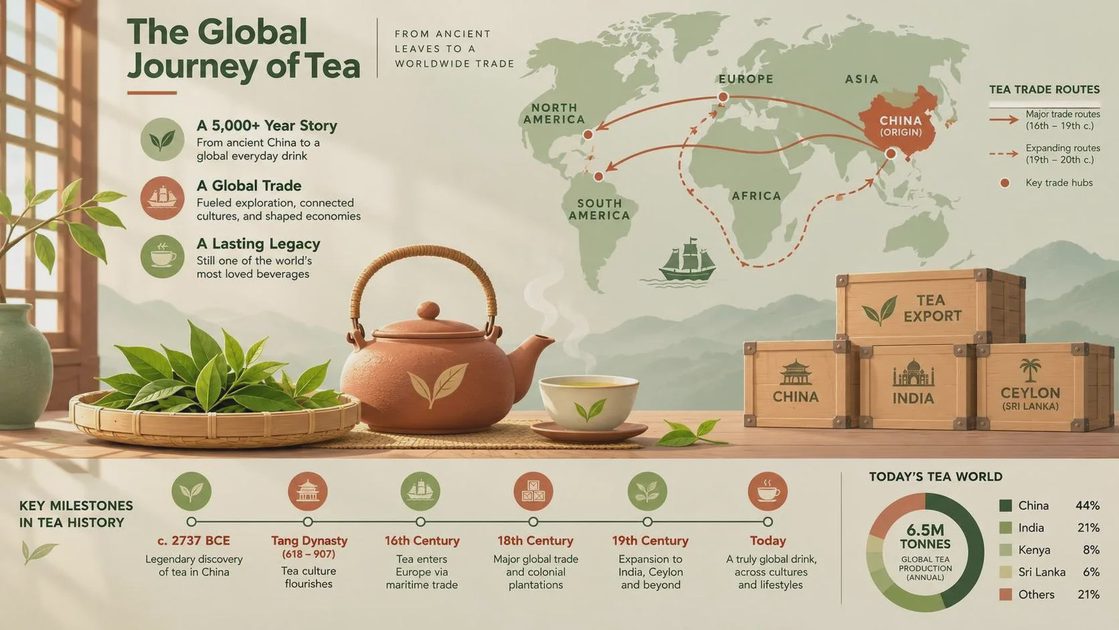
Britain's demand also helped reshape tea production in South Asia. Tea plants grow naturally in parts of northeastern India, including Assam. Under British colonial rule, plantations expanded there and in other regions, including Darjeeling. Plantation growth depended on land policies and labor systems that brought hardship and coercion as well as profit. The distinctive teas of these regions deserve appreciation without erasing the conditions under which the industry developed.
Tea in the United States and beyond
In colonial North America, tea was both an everyday commodity and a political symbol. The Boston Tea Party of 1773 was a protest connected to British taxation and control of the tea trade. It is a vivid episode in American tea history, but it was not the end of tea drinking in the United States.
Iced tea became a familiar American drink over the nineteenth and twentieth centuries. A popular story credits its invention to the 1904 St. Louis World's Fair, but recipes for cold tea appeared earlier. The fair may have helped popularize the drink; it did not establish a clear moment of invention.
The tea bag has a similarly untidy history. Small bags used for brewing were patented in the early twentieth century, and an often-repeated account links their popularity to tea samples sent out by merchant Thomas Sullivan. The precise path from sample to household staple is harder to pin on one person. What matters for today's drinker is simpler: a tea bag is a convenient brewing tool, not evidence of an inferior tradition.
Bring the history to your table
You do not need a collection of specialized utensils to explore tea history at home. Begin with a plain green or black tea and notice the dry leaf, the aroma after brewing, and how the flavor changes as the cup cools. Use the maker's instructions as a starting point; if the tea tastes harsh, try a shorter steep or cooler water.
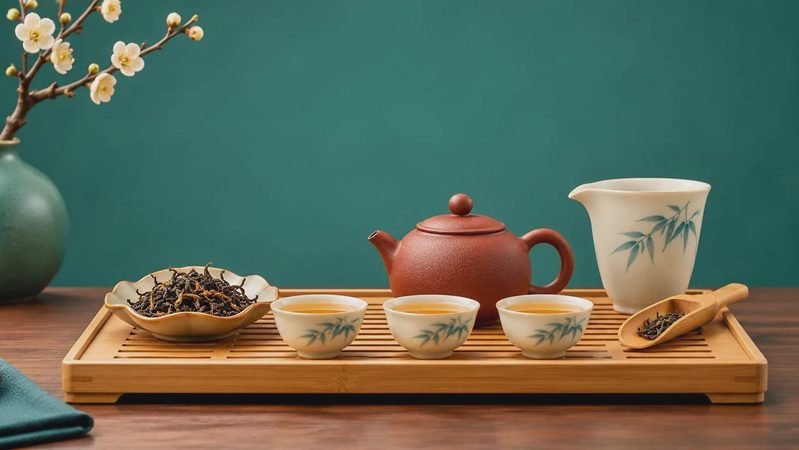
For a small lesson in objects, brew loose leaves in a pot or a roomy infuser and watch them unfurl. Then consider what the vessel allows: room for leaves to move, a handle for pouring, or a lid to hold warmth. A simple mug and strainer can do that work beautifully.
If you are curious about a particular tradition, learn its name and setting rather than treating an isolated gesture as a universal rule. You can appreciate the ritual without performing expertise. Every cup has a history. Not every story is true.



No comments yet — be the first to share a thought.