
The short version: what is a japanese tea garden? In its traditional tea-ceremony sense, it is a garden designed as an approach to a tea gathering, often leading guests along a path to a tea room. Called a roji, it is more than a pretty backdrop: the walk, the waiting area, and the water basin can all help mark a transition from everyday activity to shared tea. Not every garden with that English name follows this design, however, and not every Japanese garden is a tea garden.
What is a japanese tea garden called?
The Japanese term roji is often translated as “dewy ground.” In tea practice, it refers to the garden or approach associated with a tea room. A roji may be modest in scale, with stepping stones, restrained planting, and a place to wash before entering. Its purpose is experienced through movement: guests follow a route rather than simply looking at a composition from a distance.
The gathering itself belongs to chanoyu, a tradition of preparing and sharing powdered green tea, usually matcha. Tea gardens developed in connection with particular forms of this practice; they are not required for making matcha at home, and tea gatherings can take place without one.
In the United States, “Japanese tea garden” can also be the name of a public garden with Japanese-inspired landscape features, a place to drink tea, or both. A visitor might find ponds and bridges as well as paths and a tea house. Those features can be lovely, but their presence alone does not make the entire landscape a roji in the tea-ceremony sense.
What you might notice along the path
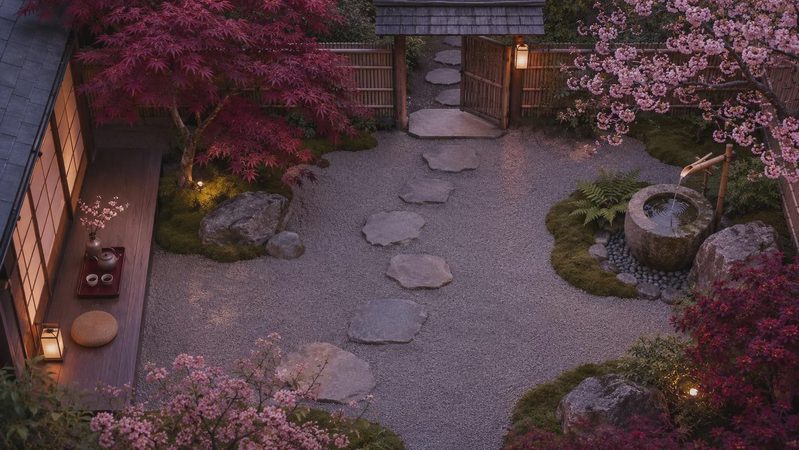
A roji is not a fixed checklist, but several features appear often. The stepping-stone path, called tobi-ishi, guides the direction and pace of a guest’s approach. Stones can be spaced and positioned to make a person pay attention to where they place their feet. In a functioning garden, they are practical surfaces as well as part of the design.
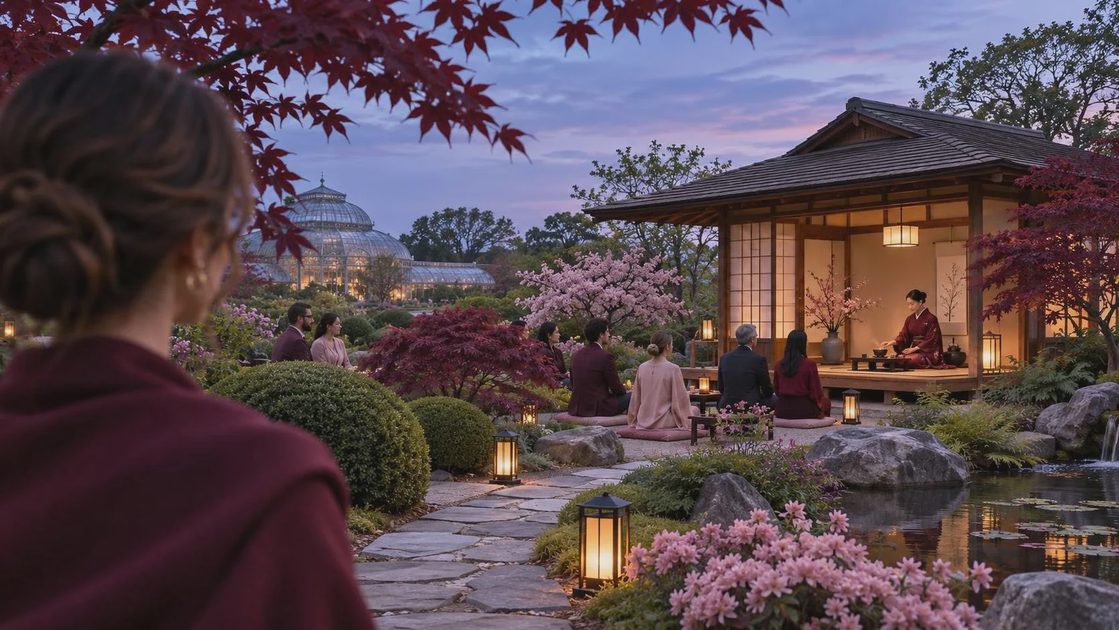
A waiting area may give guests somewhere to pause before proceeding to the tea room. Some larger roji have an outer and an inner garden separated by a gate, with the route unfolding in stages. Smaller sites may work with a much simpler arrangement. The particular layout depends on the place and the tea tradition practiced there.
A stone water basin, often called a tsukubai in this setting, is associated with cleansing the hands and rinsing the mouth before entering. The basin is typically low, so a guest bends toward it. That physical action is sometimes explained as a lesson in humility; it is also worth noticing the straightforward practical act of washing before a gathering. Interpretations and procedures vary.
You may also see stone lanterns, bamboo fencing, moss, and trees or shrubs. They are not mandatory ingredients, nor do they carry one universal symbolic meaning. A lantern can help illuminate a path; fencing can screen a view or define a boundary. Gardeners have to maintain these elements, so the apparent simplicity of a roji should not be confused with an absence of work.
How the tea garden took shape
Tea drinking reached Japan from China, and practices around it changed over centuries. By the late 1500s, influential tea practitioners were developing forms of chanoyu that valued quieter, less ostentatious settings. The tea garden became an important part of the approach to the small tea room associated with these gatherings.
Sen no Rikyu, a major figure in tea history, is closely associated with these developments. He is frequently credited in popular accounts with inventing an entire aesthetic single-handedly, but the historical record is less tidy than that. Tea practices and garden forms emerged through the work of many people and continued to change after his lifetime.
The term wabi is often used when discussing the understated character of tea spaces. In this context, it points toward an appreciation for simplicity and modesty, though its meanings have shifted and cannot be reduced to a decorating formula. A carefully made path or weathered-looking basin is not automatically evidence of some timeless, untouched tradition: gardens are designed, tended, repaired, and interpreted by successive generations.
Visiting with curiosity, not anxiety
At a public garden, begin with the posted rules. Some paths may be fragile, closed for maintenance, or reserved for a tea event. Stay on designated routes, leave stones and plants where they are, and ask before entering a tea room or photographing a gathering. A water basin may be an active part of a ceremony, a display, or off-limits to visitors; do not assume it is there for public use.
If you are attending a hosted gathering, follow the host’s guidance rather than trying to memorize every gesture in advance. Tea schools and individual hosts may handle details differently. Watch what others do, ask a quiet question when appropriate, and let someone know about a mobility concern before the event if possible. Low entrances, stepping stones, and floor seating can make access difficult, and arrangements vary by venue.
You can appreciate the ritual without performing expertise. Notice how the route changes your view, where you are invited to pause, and which sounds reach you from outside the garden. Those observations offer more than a hunt for symbolic meanings assigned to every stone.
Bringing the idea home
A home adaptation need not imitate a historic roji. Try clearing a short route to the place where you drink tea, setting out a seat, or choosing one plant to notice as the seasons change. A small tray for a cup and a few quiet minutes can create a useful pause without pretending to reproduce a formal gathering.
If you do add stepping stones or a water feature outdoors, put safety and maintenance first. Use stable, slip-resistant surfaces, and consider local water restrictions and mosquito prevention. The point is not to assemble the right decorative objects; it is to make an intentional transition into a moment of hospitality. Every cup has a history. Not every story is true.



No comments yet — be the first to share a thought.